
Newsletters + Articles
Summer Articles 2026

The Marion County Public Health Department’s Northeast District Health Office has moved to a new home at 2505 North Arlington Avenue that will provide more services for the eastside community in a larger facility.
The building, which was built in 1997, was originally used as the Eskenazi Health Center North Arlington Health Clinic. The building became available to the district health office after the clinical staff moved to Eskenazi Health Center Grande on 38th Street when it opened in early 2024.
Prior to that, the district office was located about a half-mile away, in a former bowling alley on East 21st Street office that was renovated into a health office for MCPHD in the early 1980s.
Jennyfer Voris, one of two Community-Based Care Coordinators at the district office, said the move has been a very positive one.
“We are definitely attracting attention in this facility,” Voris said. “Some people have stopped in to ask what services are offered here.”
Jane Kenyon, the other Community-Based Care Coordinator at the district office, agreed.
“We have a lot of clients in this area, and we are very happy to serve them in a larger, more welcoming setting,” Kenyon said.
The Northeast District Health Office currently has three dozen full-time employees, and offers routine and school-required immunizations, TB testing, blood pressure screenings, maternal and child health services, nutrition education, counselling, and home visits from nurses and social workers.
The Nutrition Services team now has a full test kitchen at the health office for cooking classes. Nutrition Services also offers the Infant Feeding Safety Net program at the health office, which can provide lactation support to new mothers and help provide families with a short-term emergency supply of infant formula.
In an expansion of services for the eastside community, three additional MCPHD programs will be housed at the health office.
The Diaper Den program will provide free diapers to parents who register.
The Global Health and TB Control Program will provide health screenings and follow-up care to qualifying families on Tuesdays.
The ACTION Health Center staff will provide primary care and health education to clients aged 26 and younger on Thursdays.
CUTLINES
Clinic Opening 0057 – (l to r) Olivia Younge, Assistant Administrator for Business Operations at MCPHD’s Global Health and TB Control Program; Dr. Millicent Moye, Director of MCPHD’s ACTION Health Center; at the reception window for their clinics in the health office
Clinic Opening 0175 & 0177 -- Sydnee Hake, Nutrition Fitness and Wellness Educator for MCPHD’s Nutrition Services Department, talks about the raised-bed garden near the health office’s parking lot
Kitchen photos 1-15 – Jenna Ruppert, Community Nutrition Coordinator for MCPHD’s Nutrition Services Department, gives a food-preparation demonstration in the health office’s nutrition classroom
Food and Consumer Safety
On July 1, Indiana’s Farm and Homestead Food Sales law went into effect, which created new categories of operators who can – under certain conditions – sell an expanded variety of pre-packaged foods to the public with limited regulation.
Kelli Whiting, Coordinator of Temporary Food Events for MCPHD’s Food and Consumer Safety Department, said the new rules will supplement, but not replace, the rules and categories already in effect.
“We already have rules for permanent food-service establishments and retail food stores, mobile food units, temporary food stands, and home-based vendors,” she said. “This will create new categories of homestead vendors and small-farm operators.”
Indiana laws already allowed home-based vendors to sell whole, intact produce, baked goods, honey, and frozen chicken and rabbit meat as long as the products were in sealed packages, properly labelled, and prepared by Certified Food Handlers.
The new law will allow certain types of prepared foods -- such as certain prepared sandwiches, salads, casseroles or meal kits -- eggs (except for chicken eggs, which are regulated by the Indiana State Egg Board), and meat from cattle, sheep, pigs, bison, chickens, goats and rabbits to be sold at farmers markets, roadside stands or from vendors’ own property with little additional regulation, as long as the foods are properly stored, packaged and labelled.
Janelle Kaufman, the Administrator of MCPHD’s Food and Consumer Services Department, recommended that those with questions check the MCPHD website at https://marionhealth.org/, call the department at 317-221-2222, or attend one of the informational sessions being prepared by department staff.
“We want to be a helpful resource to vendors, but caution that these exemptions include foods that are often implicated in foodborne illness outbreaks,” Kaufman said. “Customers should be conscientious, and should make decisions that are in the best interests of their health.”
CUTLINES
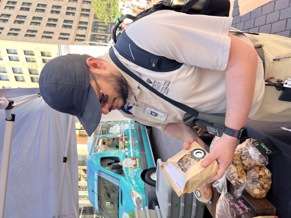
Photos 1-5 -- Jesse Acevedo, a Food Education Specialist with MCPHD’s Food and Consumer Services Department, checks the labelling of foods offered for sale to the public
Housing and Neighborhood Health
Carbon monoxide (CO) is a colorless, odorless, poisonous gas caused by the incomplete burning of fuel. Fireplaces, cars, generators and gas appliances – such as stoves, furnaces and water heaters – can be sources of CO gas.
According to the Centers for Disease Control and Prevention, CO poisoning causes more than 100,000 emergency department visits each year, and around 400 deaths.
Julianna Kennedy, Administrator of MCPHD’s Housing and Neighborhood Health Department, said that most people are aware that they need to have smoke detectors in their homes and that Marion County property owners are required to provide smoke detectors to their tenants.
But fewer are aware that MCPHD now requires CO monitors in homes with gas appliances.
In the fall of 2025, an Indianapolis student died from CO poisoning.
“Carbon-monoxide-related deaths are especially tragic because they are often preventable,” Kennedy said. “The Housing Department performed over 75,000 inspections last year. So, we are in a unique position to reach a lot of property owners and tenants.”
The housing department staff made it their mission to ramp up education on the dangers of CO poisoning, to inform property owners on their responsibilities under the health code, and to gather resources.
The department’s outreach team produced a CO brochure, which is now carried with Housing Environmental Health Specialists during site visits, and housing specialists continue to pay close attention to identifying potential sources of CO poisoning during home inspections.
The department’s Community Education and Outreach Liaison, Thasneem Najum, has since added CO education to her apartment complex tenant presentations. “Some tenants are not aware that they have gas appliances in their home and often incorrectly assume that smoke detectors will also warn them about carbon monoxide gas.” Najum said. “It’s great when we can partner with property managers to provide education to their residents as we try to make their surroundings healthier.”
Kennedy went on to say that the department is partnering with Indianapolis Public School administrators to educate parents about CO poisoning and continues to seek funding to purchase carbon monoxide monitors for those in need.
To reach the Housing and Neighborhood Health Department, please call (317) 221-2150.
CUTLINES
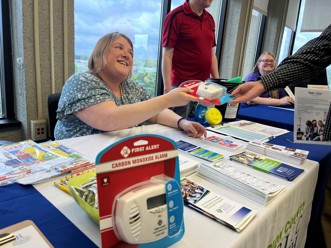
Photos 1-9 – Julianna Kennedy, Administrator of MCPHD’s Housing and Neighborhood Health Department, talks about carbon monoxide safety with participants at a health fair
CAN'T FIND WHAT YOU'RE LOOKING FOR?
Request further information below.
We're here to help.